Thursday, March 01, 2007

SMAK1 Blog Moved

Hello friends,

SMAK1 blog has moved to the following site:

http://smak1-1985.weebly.com

I think you're going to like it. Try it! and don't forget to add your comment in Guestbook tab.

Yours always

Saturday, February 03, 2007

Monday, January 15, 2007

In times of tragedy, xenophobia rears its ugly head

Xenophobia in some sectors of society has reached alarming levels. Every time there is the slightest hint of the presence of foreign forces of any kind in the country, the ugly head of xenophobia pops up.

This is evident from some of the discussions taking place on radio, television and the Internet. Statements like "foreigners are infringing on our sovereignty" and "why should the government allow them to come in" are common.

There is nothing wrong with being alert, but it is entirely different to be concerned about something which is baseless. For example, a Singapore plane with search and rescue equipment and a U.S. naval oceanographic survey ship, the Mary Sears, are currently in Indonesian territory simply to help Indonesian authorities locate the missing Adam Air jetliner.

They are here because Indonesia lacks the technology to locate the missing Adam Air Boeing 737-400. It is exactly because of the country's technological limitations that President Susilo Bambang Yudhoyono asked friendly countries to help in the search.

It is good to remind alarmists that remote sensing technology is now so advanced that advanced countries can train their satellites on any spot in the world. So there is virtually nothing we can conceal anyway. In fact, the U.S. has provided Indonesia with satellite imagery to help find the Adam Air plane.

The Singapore Fokker-50 airplane is equipped with sonar technology to detect objects on the ground as well as on the water's surface, while objects on the seabed can be detected by the Mary Sears.

It is simply rude to talk badly about our foreign friends while they may be working at this very moment with local forces in the southern Sulawesi waters off Pare-Pare, searching for the jetliner.

There are worrying signs that xenophobia is here to stay, judging from recent events. When foreign countries scrambled to Aceh after the December 2004 tsunami, the Indonesian Military (TNI) responded by restricting the movement of international aid workers and foreign military personnel.

Foreign military ships and planes also were required to be accompanied by military liaison officers and to get clearance from the TNI for all their movements.

Vice President Jusuf Kalla then told foreign troops to leave Indonesia within three months, amid allegations that the troops were engaged in espionage on behalf of their governments.

There were also concerns that the largely Western foreign volunteers were out to convert the mainly Muslim Acehnese to Christianity.

Fortunately, voices of reason made themselves heard, protesting the restrictions and even questioning the true motives of the TNI.

This ugly xenophobia again appeared after last May's earthquake in Yogyakarta. The government wasted no time in appealing for international help, but no sooner had foreign medical personnel and volunteers arrived to help victims than top leaders in Jakarta demanded to know how long they would be there.

Just like the volunteers who streamed into Aceh two years ago and Yogyakarta in May, the crews of the Singapore plane and the American ship are motivated by a strong sense of compassion for the 102 people aboard the missing jetliner.

Indonesia seems to be saying, we will take your money and aid, now get out.

If we are unable to overcome our xenophobia, the international community will be forgiven for perceiving us as an ungrateful nation.

Harry Bhaskara, The Jakarta Post, Jakarta

Thursday, January 11, 2007

Indonesian Search Teams Recover Pieces of Missing Plane

Indonesian search teams are starting to recover pieces of a passenger jet that disappeared on New Year's Day with more than 100 people on board.

The head of search and rescue operations, Eddy Suyanto, says a fisherman found the tail stabilizer in waters about 300 meters off Indonesia's Sulawesi island, near Pare Pare.

He says a partial serial number stamped on the wreckage matches that of the Adam Air Boeing 737.

Airline seats, food trays and other parts of the plane have also been found strewn along the shore on Sulawesi island.

The jet was carrying 102 people when it went down in rough weather during a flight from Surabaya on Java island to Manado on Sulawesi.

Authorities are still unsure where the plane crashed, saying the debris could have drifted great distances.

More than 3,600 soldiers, police and volunteers have been scouring Sulawesi's thick jungle and the surrounding seas for the plane for almost two weeks.

Indonesian ships and a U.S. vessel with ocean survey capabilities are being used to determine whether several large metal objects detected by sonar on the seabed off Sulawesi could be parts of the plane.

Relatives have been anxiously awaiting news of the fate of the passengers, after being incorrectly informed last week that the plane's wreckage and 12 survivors had been found.

Adam Air is one of about 30 budget airlines that have sprung up in Indonesia since the industry was deregulated in 1998.

In 2005, 17 Adam Air pilots quit after complaining of poor safety standards.

Some information for this report was provided by AP and Reuters.

Monday, January 01, 2007

Some Recent Disasters in Indonesia

_ Jan. 1: An Indonesian plane disappears in stormy weather after issuing a distress signal during a two-hour flight from East Java to Manado.

_ Dec. 29, 2006: A crowded Indonesian ferry, carrying nearly 640 passengers, breaks apart and sinks in the Java Sea during a violent storm. At least 400 are still missing.

_ Dec. 23, 2006: Days of heavy rain touch off floods that kill more than 100 people and displace over 400,000 on northwestern Sumatra island.

_ June 19, 2006: Heavy rains cause floods and mud flows that kill as many as 300 people in southern Sulawesi province.

_ May 27, 2006: A 6.3-magnitude earthquake in central Java island kills at least 5,800 people and injures more than 36,000.

_ May 2006: A series of explosions spew hot ash down the slopes of Mount Merapi, eventually forcing at least 15,000 villagers to flee their homes.

_ May 2006: Mud flows, set off by an accident deep in a drilling shaft operated by a gas exploration company, displace more than 10,000 people and cover over 1,000 acres of land on Java island.

_ Jan. 4, 2006: At least 200 people are killed when mud and rock covers the village of Cijeruk on Java island in a landslide.

_ Sept. 4, 2005: An Indonesian jet crashes in a residential neighborhood in Medan, the country's third largest city, killing at least 149 people, including 47 on the ground.

_ March 28, 2005: At least 647 people die and tens of thousands are left homeless in a 8.7-magnitude earthquake that hits Nias, Banyak and Simeulue islands off the coast of Sumatra.

_ Dec. 26, 2004: An 8.9-magnitude earthquake sets off a tsunami that kills more than 126,000 people in Indonesia, mostly in Aceh province on Sumatra island, in the country's worst disaster. More than 100,000 others die in several other countries.

© 2006 The Associated Press.
URL: http://www.msnbc.msn.com/id/16430595/

Monday, December 18, 2006

Seven dead in Sumatra earthquake

An earthquake has struck Indonesia's Sumatra island, killing at least seven people and wounding around 100 others.

Hundreds of homes were also reported to have been destroyed when the 5.7 magnitude quake hit just before dawn.

Frightened people fled their homes as a series of aftershocks followed the quake, which was felt in northern and western parts of the island.

Half an hour earlier, a 5.8 magnitude quake struck north of Sumatra, in the Indian Ocean south-west of Banda Aceh.

No tsunami warning was issued on this occasion, officials said.

However, villages were reported to have been cut off as the earthquake triggered landslides, hampering rescue operations.

The region was worst hit when a 9.1 magnitude earthquake off the Sumatran coast in December 2004 triggered a tsunami that killed more than 230,000 people around the Indian Ocean.

http://news.bbc.co.uk/go/pr/fr/-/2/hi/asia-pacific/6189165.stm

Monday, November 27, 2006

Business as usual in Indonesia despite the fall of Soeharto

By Djamester A. Simarmata, Jakarta Post

Most of Indonesia's fiscal problems are inherited from previous governments, especially from the Soeharto era. Off-budget hijinks were rampant during that period, as in the case of the foundations established by Soeharto, his family, his cronies and the military.

The fall of the Soeharto regime sparked new hope for improvement in the general welfare, stemming from better governance and better management of the country's economy as a whole. There were growing demands for transparency and good governance.

Soeharto's "one-man show" style was considered a barrier to good governance. The flow of information was very limited, especially in terms of government affairs. There were widespread cases of government expenditures not being documented in the state budget.

There was very little accountability and transparency, both on the revenue and the spending sides. There was a "dark side" of the state budget, where a significant proportion of government expenses and revenues went unrecorded.

Soeharto's methods of financing his various foundations were questionable. It was not even clear whether institutions such as the Supersemar foundation, Dakab, and others, were public or private.

Unfortunately, the latest report on the Observance of the Code of Good Practices on Fiscal Transparency from the International Monetary Fund (IMF) shows that, despite the hopes for reform, business as usual persists in Indonesia.

As a member of the IMF, Indonesia is committed to observing the code in its fiscal affairs. It consists of four pillars, namely: Clarity of Roles and Responsibilities; Public Availability of Information; Open Budget Preparation, Execution and Reporting; and the Assurance of Integrity.

According to the IMF's evaluation, publicly available fiscal data in Indonesia does not contain sufficient information on extra-budgetary issues. These include regional development and investment funds, housing funds, foundations, cooperatives, extra-budgetary funds for the sub-national level of government, and other items.

Furthermore, the report noted weaknesses in the fiscal regime in the oil and gas sector. Due to the important position of oil and gas in state revenues, there should be appropriate public disclosure of oil revenue and costs, as well as the taxation system and the calculation of oil profits. Since 29 percent of state revenue in 2006 will be from oil and gas, transparency in this sector is a must.

The report acknowledges several advances in fiscal reforms, especially the passage of the laws regarding state finances, the treasury, and the supreme audit board. How-ever, corruption has flourished at regional and local levels since the enactment of the autonomy law, both in executive and legislative bodies. This is proof of the deteriorating climate in the whole body of the bureaucracy.

The status of the Teperum housing fund created in 1993 raises some questions, because it is not formally classified as a pension program. It is financed by compulsory deductions from public servants' salaries. The funds can be withdrawn when a civil servant retires, but without interest. The program has remained off-budget. Such practices violate principles of good public fund management in terms of accountability and transparency. They constitute corruption.

Another important revelation from the IMF's report is that the Indonesian Military (TNI ) and National Police are continuing their old practice of using cooperatives and foundations to raise money from the public. These remain off-budget. Unfortunately such practices can also be found at other ministries and state agencies.

In the TNI's case, these practices violate a 2004 law stating that all TNI business must be transferred to the government. This is only one of the appropriate laws and regulations that has not been implemented. The persistence of such practices in the military proves the unwillingness of the institution to reform its businesses.

The creation of bank accounts for many public officials for the operational budgets of ministries and public institutions is another worrisome practice. The bank accounts remain in the names of officials even after they no longer hold the posts or even after their deaths. This indicates the widespread disorder of fiscal affairs in Indonesia.

The question begs to be asked, why were these accounts created in the names of the officials concerned, and not in the name of the institution? For instance, the question of recent personal accounts for high-ranking police officials has not been clarified. This once again throws the credibility of these institutions into doubt.

Given the seriousness of these off-budget problems, the House of Representatives must take action to solve them. The government can contribute to the effort by raising these issues in public and practicing transparency in its fiscal matters.

These problems are even more serious in light of a recent Merrill Lynch report. It found that a third of the wealthiest individuals in Singapore are Indonesians from the ranks of active and retired high-ranking officials and businesspeople.

The writer is a lecturer at the faculty of economy, University of Indonesia.

Thousands of Indonesian mudflow victims protest

SURABAYA, Indonesia, Nov 27 (Reuters) - Thousands of Indonesians blocked a key road on Java island with truckloads of sand on Monday to press the operator of an exploratory oil well spewing torrents of mud to pay more compensation.

Some 10,000 people have been displaced and entire villages inundated by the mud that has flowed since a drilling accident in May, causing an unfolding environmental disaster in the Sidoarjo area, near Indonesia's second largest city of Surabaya.

"We are here to claim our rights as Indonesian citizens. A few days ago, we not only lost our houses but also our paddy fields and all the infrastructure because of Lapindo," Muhammad Kudori, a representative for the protesters, said after meeting top local officials and the head of the operator of the oil well.

The Banjar Panji well was operated by Indonesia's Lapindo Brantas, a unit of PT Energi Mega Persada , partly owned by the Bakrie Group, which is controlled by the family of Indonesia's chief social welfare minister Aburizal Bakrie.

The firm has denied the mud flow is directly linked to the drilling operation.

So far the company has offered a monthly stipend of 300,000 rupiah ($32.86) to villagers who have lost their houses and rent for new accommodation. It has also set aside 6.9 billion rupiah to cover agricultural losses over the next few years.

Anger has been mounting in the area with the hot mud gushing at a rate of 50,000 cubic metres (1.75 million cubic feet) a day from the well despite several government contingency plans to plug the leak.

Many of the protesters who gathered outside the Sidoarjo regent's office had lost their homes and fields in the past week because of the mudflow, which was also blamed for a gas pipeline explosion in the area last Wednesday that killed 11 people.

"I agree with your demand on the compensation of houses and buildings," Basuki Hadimulyo, managing head of a national task force formed by the government to tackle the mudflow, said.

"I will fight for your rights in Jakarta."

In the middle of negotiations, the representatives of the victims walked out as national team could not guarantee the compensation they demanded.

The protesters blocked a road connecting Surabaya with northern cities of East Java with three trucks of sand.

Several experts have said the mudflow could have been triggered by a crack about 6,000 feet (1,800 metres) deep inside the well.

Thursday, November 16, 2006

Fed Cup: Indonesia to pay US$ 39,000 fine

JAKARTA, Nov. 16 (Xinhua): Indonesia must pay a fine of more than US$ 30,000 to the International Tennis Federation for its refusal to play Israel at the Fed Cup women's team tournament in Tel Aviv in July.

The Indonesian Tennis Association has confirmed it received an email from Fed Cup Executive Director, Juan Margets, about the penalty, The Jakarta Post newspaper reported Thursday.

The Fed Cup Committee decided to fine Indonesia at its meeting on Sept. 15.

Indonesia must pay 20,000 dollars of the fine to the host, Israel, 6,600 dollars to the ITF to compensate for its preparations for the match and 5,000 dollars to the ITF for refusing to play.

Worse still, Indonesia will also be barred from taking part in the 2007 Fed Cup competition. The country is given until December 20 to appeal against the decision.

Indonesia, which has no diplomatic relations with Israel, decided to withdraw from the Fed Cup match against Israel to show solidarity with Palestine following Israeli attacks on the Gaza Strip.

Due to its refusal, Indonesia lost its spot in the World Group two and will have to play in Asia/Oceania Zone Group two in 2008.

Wednesday, November 15, 2006

Suspect admits Poso murders role

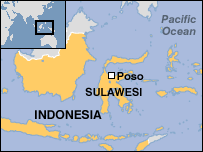
A suspected Muslim militant has admitted he was involved in the 2005 beheading of three Christian schoolgirls in Indonesia's Sulawesi.

Hasanuddin, 34, told a Jakarta court he helped plan the attack but he rejected allegations he masterminded it.

He said he wanted to avenge the deaths of Muslims killed during religious violence in the country, the world's most populous Muslim nation.

He and two other suspects could be sentenced to death if found guilty.

The murders shocked Indonesia and threatened to reignite violence between Sulawesi's Muslims and Christians, which has continued despite a 2002 peace deal.

'Revenge'

"I was indeed involved in the beheadings," Hasanuddin told the court.

"With honesty and sincerity coming from my heart, I ask for forgiveness from the families of the victims. I promise to never repeat it again," he said, according to the Reuters news agency.


VIOLENT PAST
Previously known as Celebes, Sulawesi is Indonesia's fourth largest island
80% of residents are Muslim, while 17% are Christian
A December 1998 brawl in Poso led to months of religious violence in which hundreds died


"But we did it because authorities did nothing about massacres of Muslims."

Prosecutors accused Hasanuddin of masterminding the attack.

They said two other defendants - Lilik Purnomo and Irwanto Irano - were following his orders when they helped carry out the attack.

A defence lawyer for the two said they could not accept the charges as they were not based on facts.

Several others who took part in the ambush remain at large.

The three schoolgirls were attacked as they walked to the private Christian school near their home in the town of Poso, in central Sulawesi.

One of their heads was discovered outside a church.

Sulawesi has long been the scene of violent attacks between Christians and Muslims.

Tensions have risen in recent weeks following the execution of three Christian militants in September, for attacks against Muslims in 2000.

More than 1,000 people are believed to have been killed during two years of violence triggered by a brawl between Christian and Muslim gangs in December 1998.

Wednesday, November 08, 2006

Indonesia's historic botanical gardens dug up to make helipad for US president

Workers are digging up a patch of historic botanical gardens near Indonesia's capital to make a helipad for U.S. President George W. Bush's arrival later this month, adding to anger at his planned trip.

The chief of the vast garden, built in 1817, said he had initially rejected the plan to allow Bush to land there amid fears that wind generated by his chopper would damage the park's trees, plants and orchids.

"At the very least, the branches and twigs will break," Sujati Budi Suseteyo told the Media Indonesia daily.

Bush is tentatively scheduled to visit Indonesia — the world's most populous Muslim nation and a close ally in Washington's war on terror — on Nov. 20, upon his return from the Asia-Pacific Economic Cooperation meeting in Vietnam.

He will fly to the gardens in Bogor, a hilltop city on the southern outskirts of the capital Jakarta, via helicopter from the country's main international airport. He will then hold talks with President Susilo Bambang Yudhoyono in an adjoining palace.

The country's largest opposition party, the Indonesian Democratic Party of Struggle, said in a statement allowing Bush to land in the park was "neglecting the country's environmental heritage at the expense of political considerations."

Media reports say much of Bogor will be declared off-limits to residents during the meeting.

"Why must Bush be treated like some sort of god?" said Amien Rais, the head of an Islamic-leaning political party, state news Antara reported. "Just meet him at the airport, serve him up some tasty fried rice, a cup of hot coffee, speak with him as needed and then invite him to return home."

Several Muslim groups are vowing to protest the trip by Bush, who is unpopular among many people because of the U.S.-led wars against Afghanistan and Iraq and a perception his proclaimed war on terror unfairly targets Muslims.

Indonesia has been hit by a series of terrorist attacks targeting Western interests since 2002, with suicide bombings on the resort island of Bali and in Jakarta together killing more than 240 people.

The government has arrested hundreds of Islamic militants, winning praise from Washington, which last year rewarded it by lifting a six-year arms embargo imposed after Indonesian troops went on a deadly rampage in East Timor.

A spokesman for Yudhoyono said Tuesday that the two leaders would discuss U.S. investment in Indonesia, and would boost cooperation in health care and education. Terrorism may also be brought up on the sidelines of the talks, officials have said.

Thursday, November 02, 2006

Arrests over violence in Sulawesi

Fifteen Muslim men have been arrested in connection with a spate of attacks on the Indonesian island of Sulawesi in recent years, police say.
The attacks include the beheading of three Christian schoolgirls last year and the bombing of two markets in 2004.

Sporadic attacks between Sulawesi's Muslims and Christians have continued despite a peace deal signed four years ago that put an end to fighting.

There has been a surge in attacks in the province in recent weeks.

The men were arrested after an eight-month investigation, police said. Another 29 suspects are still at large.

VIOLENT PAST
Previously known as Celebes, Sulawesi is Indonesia's fourth largest island
80% of residents are Muslim, while 17% are Christian
A December 1998 brawl in Poso led to months of religious violence in which hundreds died


They are suspected of being involved in 13 separate attacks between 2001 and 2006.

These include the beheading and mutilation of three teenage girls who were attacked on their way to school near the city of Poso, in eastern Sulawesi, in October 2005.

The recent rise in tension on Sulawesi has been attributed by many to the execution of three Christians in September for their role in the province's long-running conflict, the BBC's Lucy Williamson in Jakarta says.

But others say it is the heavy presence - and behaviour - of the security forces which is fuelling the unrest, she adds.

Indonesian Vice-President Yusuf Kalla is in the province this week to meet religious leaders and try and ease the tensions.

Story from BBC NEWS:
http://news.bbc.co.uk/go/pr/fr/-/2/hi/asia-pacific/6101680.stm

Monday, October 30, 2006

Tommy Suharto freed from prison

The son of Indonesia's former President Suharto has been freed from jail on conditional release after serving only four years of a murder sentence.
Hutomo Mandala Putra, also known as Tommy, was given a 15-year sentence in 2002 following his conviction for ordering the killing of a judge.

His sentence was first cut to 10 years, and then reduced further.

Human rights activists and anti-corruption campaigners have voiced strong opposition to his release

Scuffles broke out as he was driven from the prison in east Jakarta.

His van was surrounded by dozens of reporters and photographers as he left for the prosecutor's office, where his release was made official.

'State of law'

Officials said Tommy Suharto was eligible for release after receiving his most recent sentence reduction along with thousands of other prisoners to mark Eid al-Fitr, the end of the holy Muslim month of Ramadan.

Under Indonesian law, prisoners who have shown good conduct and have served more than two-thirds of their sentence once the remissions are taken into account are eligible for parole.

Vice President Yusuf Kalla rejected criticism that the Indonesian authorities were favouring him because of his family connections.

"This is a state of law," he told reporters. "Once he completes his sentence ... he should be released."

Officials said he would remain on parole for a year.

A leading Indonesian human rights lawyer, Johnson Pandjaitan, said it was wrong to view the release as automatic.

"Conditional release is never automatic. Nothing is really automatic. It should go through a certain process," he told Reuters news agency.

Embezzlement charges

The 44-year-old former playboy was found guilty in 2002 on charges of murder, weapons possession and evading justice.

He was convicted of masterminding the assassination of Supreme Court Judge Syafiuddin Kartasasmita who was shot dead by gunmen on a motorcycle.

Judge Kartasasmita had himself convicted Tommy for corruption and illegal possession of weapons.

Tommy's father Suharto stepped down in 1998 amid an economic crisis and rising discontent.

The 84-year-old ailing former leader is accused of embezzling millions of dollars in state funds during his three decades in power, a charge he denies.

Thursday, October 26, 2006

U.S. President Bush to Visit Indonesia, Singapore Next Month

By Arijit Ghosh

Oct. 24 (Bloomberg) -- U.S. President George W. Bush will travel to Indonesia, which has the world's largest Muslim population, and Singapore next month when he attends the 14th Asia-Pacific Economic Cooperation Leaders meeting in Vietnam.

Bush will be in Hanoi for the meeting on Nov. 18 and Nov. 19, the White House said yesterday in a statement posted on its Web site.

Bush's visit to Indonesia will be the culmination of high- level Western leaders meeting President Susilo Bambang Yudhoyono in Jakarta this year. The U.S. has described Indonesia as a ``voice of moderation in the Islamic world'' and that nation's Secretary of State Condoleezza Rice visited the country on March 15. Her visit was followed by Tony Blair, the first British prime minister to visit Indonesia since Margaret Thatcher in 1985.

Yudhoyono, Indonesia's first directly elected president, has cracked down on terrorism and corruption and last year signed a peace accord with rebels in the western province of Aceh, ending a conflict that killed more than 12,000 people in nearly three decades of fighting.

Wednesday, October 11, 2006

Indonesian Murder Acquittal Angers Rights Groups

JAKARTA, Indonesia, Oct. 8 -- Human rights groups on Sunday criticized Indonesia's Supreme Court for overturning the 14-year prison sentence of a man convicted of killing the country's most prominent activist.

Munir Said Thalib, a human rights lawyer who was threatened in the late 1990s after revealing abuses by the Indonesian military, died of arsenic poisoning in September 2004 on a flight from Jakarta to Amsterdam.

The Supreme Court said last Tuesday that it had seen insufficient evidence to support a decision by a lower tribunal that an off-duty pilot, Pollycarpus Budihari Priyanto, had laced Munir's food with poison.

The acquittal has angered many in Indonesia, where the case was seen as a test for a legal system still plagued by corruption after nearly three decades under dictator Suharto. The Suharto government, toppled by a popular uprising in 1998, was known for imprisoning and killing its political opponents.

"The failure to secure a conviction for Munir's murder is a huge blow for human rights protection and the reform process supposedly underway in Indonesia," Brad Adams, Asia director for the New York-based group Human Rights Watch, said in a recent statement.

Munir's wife, Suciwati, who like many Indonesians goes by a single name, maintains that the killing was the result of a conspiracy by military intelligence officials angered by her husband's activism.

She has said the key to Munir's case lies in a trove of telephone taps between a high-ranking Indonesian general and the pilot, which the intelligence service refuses to make public.

That theory was supported by Asmara Nababan, an Indonesian human rights activist and member of the fact-finding team established by the government last year to probe the case. The team concluded that Priyanto had had contact with an agent from Indonesia's intelligence agency, information that never surfaced in court.

Saturday, September 23, 2006

Mob Attempted to Demolish Christian Church

Yuli Tri Suwarni, The Jakarta Post, Bandung

The suppression of religious freedom in this predominantly Muslim nation continues in West Java, where dozens of churches and places of worship have been forcibly closed by Muslim extremists over the past year.

A mob of around 50 people attempted Saturday to demolish a house they claimed was being used illegally by Christians as a place of worship in the hamlet of Cibintinu, Arjasari village, some 20 kilometers south of Bandung.

But police foiled the attempted closure of the church, telling the mob that neither individuals nor organizations were authorized to shut any house of worship.

The incident took place a day before Muslims across the country started the fasting month of Ramadhan.

The abortive attempt received the backing of Muslim hard-liners grouped under the Anti-Apostasy Division (DAP) of the Islamic Ulema Forum (FUUI) led by Suryana Nur Fatwama.

The move began at around 9 a.m. after a meeting at a nearby mosque. The mob then marched to Yayasan Penginjilan Roti Kehidupan church, where they talked to church administrator Ibu Eri.

As she refused to close the church, the crowd tried to start destroying the roof of the building. Around 10 policemen then arrived at the scene and told the mob to leave.

"We ask all of you to be patient. Anybody who tries to touch this building will be arrested," said Bandung Police chief Adj. Sr. Comr. Suparman who arrived later.

He said no group was allowed under the law to close down or demolish a house of worship except the local authorities.

The mob later dispersed but insisted that they would return to the scene if the church continued its activities.

According to Faidin, a local neighborhood official in charge of spiritual affairs, the church started activities two weeks ago, around one year after being "closed" by local residents.

"It has a congregation of only seven members, including two residents from the local village. The two had just converted to Christianity," Faidin said.

"We are disturbed by their presence and worried if they spread their teachings among local residents who are nearly 100 percent Muslim," he added.

No local Christian leaders were available to respond.

Under the revised joint decree issued earlier this year by Religious Affairs Minister Maftuh Basyuni and Home Minister M. Ma'ruf, the establishment of a house of worship must gain the approval of at least 60 local residents and have a minimum of 90 followers.

Churches in several cities across West Java have been under threat due to the actions of Islamic extremists including the Islam Defenders Front (FPI) and the Alliance of Anti-Apostasy Movement.

The number of churches forcibly closed in West Java alone since September 2004 is reported to be 30. Dozens of other churches were also forced to close in other provinces.

The UK-based human rights watchdog Christian Solidarity Worldwide (CSW) has warned of the increasing trend in church closures in West Java, raising international concern
.

Thursday, September 21, 2006

Indonesia Executes Three Christians

JAKARTA, Friday, Sept. 22 — The European Union tried to get Indonesia to declare a moratorium on the death penalty, European diplomats and Indonesian officials said, as firing-squad executions loomed for three Christians convicted in connection with anti-Muslim communal violence in 2000 and for three Muslims convicted for their roles in the 2002 Bali bombings.

But the government went ahead on schedule, putting the three Christians to death in Palu, on the island of Sulawesi, shortly after midnight on Friday, the lawyer for the three men told Agence France-Presse. Other news agencies also reported the executions, citing government officials they did not name.

“The European Union, along with many other like-minded countries, opposes the use of the death penalty in all circumstances,” the Finnish Ambassador, Markko Niinioga, wrote in a letter that was delivered Wednesday to Indonesian president, Susilo Bambang Yudhoyono. “The E.U. finds this punishment cruel and inhuman,” he wrote.

Ambassador Niinioka was writing on behalf of the European Union because Finland now holds the union’s rotating presidency. His letter was read to The New York Times on Thursday by a European diplomat, who did so on the condition of anonymity because the letter had not been released publicly. An aide to President Yudhoyono confirmed that it had been received.

Mr. Yudhoyono is considered a leading contender for the Nobel Peace Prize, because of his work in bringing about an end to the separatist war in Aceh, the country’s westernmost province. European diplomats said on Thursday that the executions could hurt his chances, given the strong anti-death-penalty sentiments among European governments.

A senior Indonesian government official, who was granted anonymity in order to learn the government’s response, said on Thursday that despite the letter, there was almost no chance of stopping the execution of the Christians. “We’re going to execute the Bali bombers soon after,” he added, by way of explanation.

In this overwhelmingly Muslim country, the government considers that the risk of political protests would be too great if it executed the Bali bombers and not the Christians.

The trial and conviction of the three Christians — two mechanics and a farmer —was in some manner a culmination of the Muslim-Christian violence that consumed Poso, a town in the province of Central Sulawesi, for eight years.

The condemned men were Fabianus Tibo, 60, Marinus Riwu, 48, and Dominggus da Silva, 42. When they were tried in 2001, no witnesses testified about seeing any of the men actually kill anyone, according to Dave McRae, a specialist in the Poso conflict at the Australian National University who wrote about the case in The Jakarta Post on Wednesday.

Mr. McRae, who attended the trial, wrote that the evidence against Mr. Riwu “was very weak,” with the only testimony against him saying that he had instructed other Christians in the use of arrows.

Even so, the three-judge court found that Mr. Tibo was the leader of a Christian militia called the “Red Group,” and that Mr. da Silva was one of his lieutenants.

More than 150 men have been tried in connection with the Poso violence, but only a handful of them were Muslims, the Associated Press reported. None of the other defendants received a sentence more severe than 15 years in prison, according to Mr. McRae.

The executions of the three men were originally scheduled for early August, but they were postponed at the last minute following an appeal by Pope Benedict XVI. After that, the scheduled executions of the Bali bombers was also postponed; with the Muslim holy month of Ramadan beginning on Sunday, it will probably be late October before a new date is set for them.

Monday, September 11, 2006

Student could face six years for insulting President

The Jakarta Post, Jakarta

The prosecution asked the West Jakarta District Court on Monday to sentence a student to six years in prison for insulting President Susilo Bambang Yudhoyono and Vice President Jusuf Kalla during a protest in June.

Prosecutor Agung Ardyanto said Fahrur "Paunk" Rohman, 20, a student at Syarif Hidayatullah State Islamic University, insulted the head of state in a speech during a protest organized by the Alliance of People's Movements and the Try Soeharto Movement. The protest took place on the campus of National University in West Jakarta.

"The defendant violated the Criminal Code by insulting the head of state," he told the court.

Agung also accused Paunk of distributing insulting posters and flyers during the protest.

The prosecutor said the posters depicted the President and Vice President, with the words "No Trust", "Down" and "We can't take it anymore".

He said the flyers contained the words, "SBY-JK have failed and betrayed reform. Down with SBY-JK right now."

Paunk is being tried under an article in the Criminal Code that was enacted during the Dutch colonial era to protect colonial rulers from defamation. Legal scholars and human rights activists have for years advocated for the article to be scrapped, arguing it infringes on people's freedom of expression.

Meanwhile, two students were detained by the Jakarta Police on Monday after throwing rotten eggs at Deputy Attorney General for Special Crimes Hendarman Supandji at the House of Representatives.

Jayabaya University student Fariz, 22, a member of the Anti-Manipulation at State Enterprises Student Movement (Geram BUMN), allegedly threw three rotten eggs at Hendarman during a recess in a meeting between the Attorney General's Office and House Commission III for legal affairs.

According to the student group's coordinator, Akbar Kiahaly, about seven security guards tackled Fariz and another Geram BUMN member, Dipa, who is a student at the Institute of Social and Political Sciences.

"They beat up Fariz and Dipa and kicked them in the face," he alleged.

Akbar said the group threw rotten eggs at Hendarman in protest over the failure of the Attorney General's Office to prosecute graft suspects.

"There were 20 of us who made it into the House and we brought three kilograms of rotten eggs."

Thursday, August 24, 2006

Even selling your own flesh is a tough job today

By Kornelius Purba, Jakarta

The complaints of a Muslim waitress who works at an all-pork restaurant in a Bandung shopping center and a Jakarta taxi driver who has not picked up a single foreigner for months about the country's economy are very simple, but based on real-life experiences.

And the stories of these two people serve as a direct challenge to the rosy economic picture painted by President Susilo Bambang Yudhoyono in his State of the Nation address two days before Independence Day on Thursday. Even the President's most outspoken critics could not offer such a clear rebuttal to Yudhoyono as this waitress and taxi driver.

"Selling pork is unimaginable for me as a Muslim. But I have no choice. Even selling your own flesh is a tough job these days," the waitress said when asked why she worked in the restaurant. And she is even worried about losing this job because of slow sales.

Judging by the lack of foreigners he has seen in Jakarta, the driver for Putra Taxi is confident in saying that foreign investment has continued to drop off in the past several years.

During the Soeharto years, he could pick up at least one foreigner a day. "But over the last two years, I have gone months at a time without meeting a single foreigner."

In his speech, where he also delivered a draft of the 2007 state budget, Yudhoyono proudly announced the country's economy was growing steadily, and that unemployment and poverty had declined significantly. He also said he was pleased to say that foreign direct investment was increasing.

Listening to Yudhoyono speak was a lot like listening to the annual speeches of his four predecessors -- excluding Sukarno, because I never paid attention to his speeches. Soeharto, of course, is a special case because no one dared to openly criticize his speeches.

As a friend said, Yudhoyono was not entirely wrong when he cited rather outdated data to support his claims about declines in poverty and unemployment. "You can claim that you are fit, citing a clean bill of health given to you by your doctor. You just don't mention the doctor saw you a year ago."

Several senior economists criticized the President's speech, and also blamed his speechwriters and economic ministers for providing misleading statistics. But if their positions were switched, and they were in government, they'd probably do the same thing.

When the waitress said "even selling your own flesh is a tough job", no further explanation is needed to understand how difficult life is here, at least in her view.

The taxi driver may not understand statistics, but even Investment Coordinating Board chairman M. Lutfi would find it hard to argue with his observation that foreign investors have abandoned the country.

The President should not be irritated with his critics. Ordinary people -- the silent majority -- never take his promises seriously. For them it is just a matter of routine for a president to talk about all the good things his government is doing. The President was elected by the people and is being paid to make the country better. And most people are quite happy with him because they know he works very hard (not necessarily very smart).

Ordinary people will not complain much even when their leaders are not able to ease their suffering. Sure, they might get upset if their leaders are so busy enriching themselves they neglect the people. But Yudhoyono is not like that. His ambition is to enrich the nation, although ambition is completely different from reality.

Independence Day passed last week. But please, do not let me wait for another year to make an observation about what freedoms we still have. (Perhaps only freedom of speech is left.)

I met the waitress on the morning of Aug. 17 in Bandung, and the taxi driver later that same day in East Jakarta. For these two, independence means the ability to have an "appropriate job and a decent income".

When the nation celebrated its 61st year of independence on Thursday last week, our founding fathers may have been weeping in their graves as people across the country asked, "Are we really independent?"

Sure, millions of people were happy to celebrate Independence Day and people are always grateful that God granted them independence from colonial powers (although the government often acts more heartlessly than the colonialists, and people are still unable to liberate themselves from the government). In the last eight years, our leaders have continued to boast that the economy is growing and the glory days we enjoyed a long time ago will soon return.

Despite the gloomy situation, I am still confident in saying Indonesia is a great nation. Why? Because we never look back (wise men call it introspection), but continue to prepare ourselves for the incoming disasters and misery! Why should we learn from history when neglecting that history helps us feel there is nothing wrong with us?

The writer can be reached at purba@thejakartapost.com.

Wednesday, August 16, 2006

Indonesia cuts Bali prison terms

Nine Islamic militants jailed in Indonesia over the 2002 Bali night club bombings have had their sentences reduced to mark Independence Day.

It is an Indonesian tradition to cut jail terms on holidays and an Australian drug-smuggler had her 20-year sentence reduced by two months.

The bomb attacks killed 202 people, many of them foreign tourists.
The nine Islamists being held in Bali's Kerobokan prison had their sentences cut by four months, an official said.

It was not immediately clear if other militants convicted over the Bali attacks would get their sentences cut.

Australian citizen Schapelle Corby was jailed in May 2005 for smuggling marijuana into Balihad.